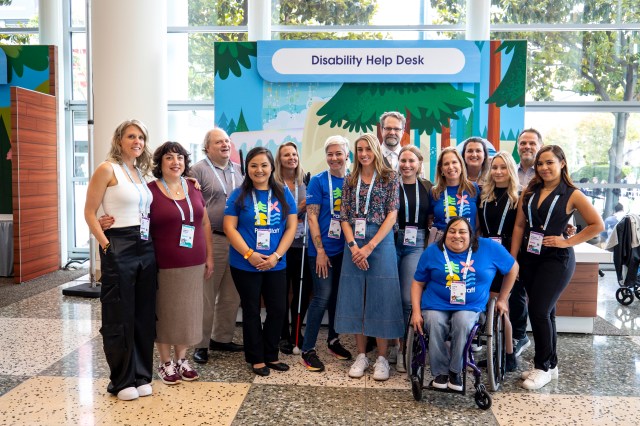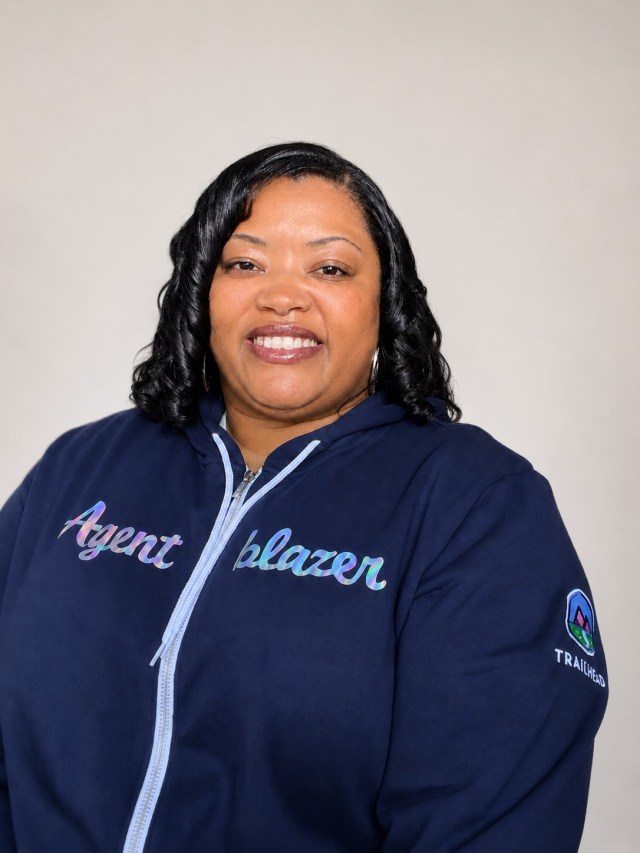
When Lamonica Hayes connected with the Center for Independent Living (CIL), she was rebuilding her confidence after brain surgery and looking to re-enter the workforce. She’s also a parent to a child with autism, so accessible training and flexible career opportunities are especially important to her.
Shortly after Lamonica started working with the CIL, they introduced her to Salesforce Workforce Navigators (WFN) and she enrolled in an AI-focused training program offered through a partnership between the two organizations. That decision would open doors to a future that Lamonica hadn’t yet imagined.
“I was hesitant at first,” she recalled. “But after receiving some encouragement, I thought, ‘Okay, I’ll give it a try.’ It turned out to be amazing.”
Through the program, Lamonica learned the fundamentals of AI, built her first AI-powered chatbot, earned her Agentblazer Champion badge, strengthened her resume and LinkedIn profile, and began exploring careers in the Salesforce ecosystem. For Lamonica, the program has also led to leadership opportunities and increased confidence in navigating her career path.
“I’ve had to learn, unlearn, and relearn how to retain information,” she said. “Not giving up on myself, but giving grace because there’s a lot to learn about technology but I’m grateful it’s a tool to support different types of brains and having that mentorship—that’s what I loved about the program.”
Lamonica is one of multiple participants showing what happens when people with disabilities have access to emerging technology, mentorship, and a supportive community. Across the first AI-focused cohort, participants didn’t just gain technical skills—they discovered they belonged in the future of AI.
Expanding Access to AI
Stories like Lamonica’s are exactly why WFN and the CIL are expanding their partnership.
For several years, the organizations have worked together to connect people with disabilities to career coaching, mentorship, and workforce development opportunities. Now, as AI rapidly transforms every industry, the partnership is evolving to ensure disability communities have access to AI education from the very beginning.
The program combines weekly instructor-led AI classes, Salesforce Trailhead, one-on-one mentorship, interview preparation, and interactive learning with Agentforce—the AI agent platform from Salesforce that delivers 24/7 autonomous support at enterprise scale.
For Lucia Rios, Workforce Navigators Senior Analyst at Salesforce, the goal goes beyond teaching people how to use AI tools like agents.
“People are already using ChatGPT, Claude, and other AI tools like Agentforce,” she said. “But they don’t always understand what’s happening behind the scenes. Through these classes, participants learn the fundamentals of AI and AI agents together, ask questions, build agents, and decide where they want to take their careers next.”
Just as important was learning together.
“We could break down large, confusing topics together,” Lucia said. “Everyone cheered each other on. It was challenging, especially for participants without technical backgrounds, but they kept showing up and celebrating every milestone.”
That collaborative environment helped transform uncertainty into confidence—one badge, one conversation, and one breakthrough at a time. Throughout the program, veterans, career changers, and job seekers with a range of disabilities discovered something they hadn’t expected: that they belong in the world of emerging technologies. For many participants, that realization was even more meaningful than earning badges.
“At first, I had some concerns about how AI would impact people with disabilities,” participant Alfonso Ramirez said. “Now, I’ve learned that we can use AI to help us with all kinds of things, like brainstorming ideas, organizing projects, and exploring employment opportunities. It’s like having a partner that helps you move forward.”
Alex Braithwaite found confidence through a different part of the program: mentorship.
“For me, connecting with a mentor from Salesforce was the best part,” he said. “It helped prove to myself that I could get through the modules and keep learning.”
For Air Force veteran Elisha Silvas, the program completely shifted what she imagined for her career path. After transitioning away from physically demanding work because of injuries, she joined the cohort with little technical experience. Today, she’s pursuing Salesforce Administrator certification and continuing to learn through Trailhead.
“I feel seen by Salesforce and Workforce Navigators—seen for my curiosity and eagerness to learn,” she said.
Why Disability Perspectives Matter in AI
For Berkeley CIL, the opportunity extends far beyond workforce development.
Laurence Carew, Computer Training and Technology Support Coordinator for the CIL, believes AI has the potential to become one of the most powerful accessibility tools available.
“I hope people start to look at AI as an accessibility tool and a necessity,” he said. “Whether it’s summarizing information, helping someone stay focused, or making content easier to understand, AI is doing many of the things the disability community has been requesting for years.”
The CIL is already putting that vision into practice through projects like Lilly, an AI-powered intake system, and a caregiver matching platform that uses AI to recommend the best pairing between clients and caregivers.
Those projects reflect a larger truth: people with disabilities are helping build what’s next when it comes to AI, and it’s critical to ensure that they are included in the conversation from the beginning.
“People with disabilities have historically been left out of conversations around emerging technology,” said Camiel Hayes, the CIL’s Youth and Vocational Program Manager. “It’s even more important that people with disabilities can shape this technology and contribute their lived experiences, because that’s how innovation is driven.”
Looking Ahead
As AI and AI agents reshape the future of work, partnerships like the one between Workforce Navigators and Center for Independent Living ensure that people with disabilities can help drive the direction of AI development. That’s why Workforce Navigators plans to expand this model to additional nonprofit partners, help more participants become Agentblazer Champions, and continue preparing job seekers for an AI-powered workforce.
“Our hope is that participants will continue learning, growing, and using these experiences throughout their careers,” said Lucia.
After all, the future of AI includes everyone—and this partnership is helping ensure people with disabilities are part of building it from the very beginning.

![[Alt text: A woman sits at a desk with her laptop open. A blue screen floats between her and the laptop, displaying a live class, course materials, and an assessment in one place.]](https://workforcenavigators.salesforce.com/wp-content/uploads/2026/09/AI-for-Higher-Education-Image.jpg?w=512)